
SHASHo vs. Normal: Conditioning the Sharpe Ratio Estimator’s Sampling Distribution

Does SHASHo beat the Normal for the Sharpe ratio estimator? Six S&P 500 windows at 5-minute, 1-hour and daily frequencies, tested against a formula benchmark.

Does SHASHo beat the Normal for the Sharpe ratio estimator? Six S&P 500 windows at 5-minute, 1-hour and daily frequencies, tested against a formula benchmark.
Final impressions on Nicole Konigstein’s Agentic AI for Finance certification with Packt: loop engineering, evaluation, security, and deployment for finance teams.

Series finale: if López de Prado et al.’s conditional variance improves Sharpe ratio inference, could a fully conditional SHASHo do the same, and more?
I am back for the second half of Nicole Königstein’s live 4-day “Agentic AI for Finance Certification” bootcamp (Packt Publishing), which teaches you how to:

On September 19, from 15:30 to 19:30 CEST, I’ll be joining a hands-on, virtual workshop presented by Packt Publishing and led by Dr. Alessandro Negro, Chief Scientist at GraphAware — and I wanted to share why I’m looking forward to it.
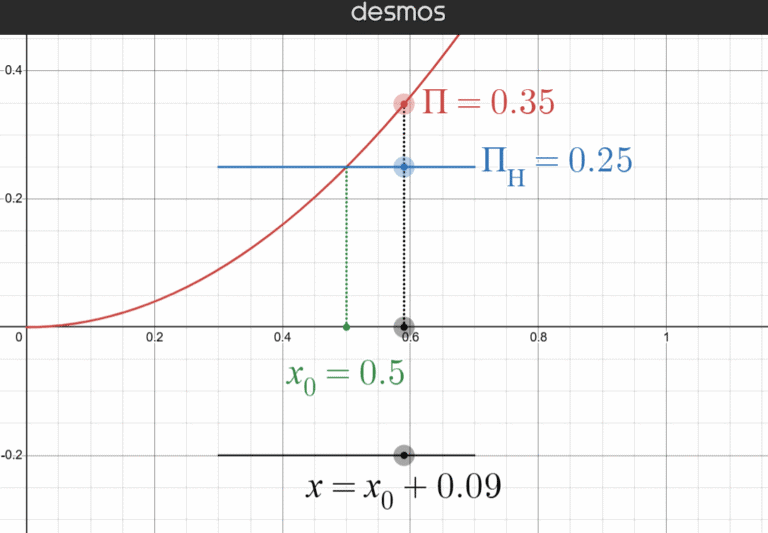
This post presents a conceptual method for constructing hedging strategies using numerical approximations of derivatives with respect to tradable risk factors. Focusing on a selected factor, we show how first- and second-order sensitivities of portfolio value can be estimated from models or data-driven sources. These are then used to build hedges that neutralize both linear and curvature risk, enabling robust, model-agnostic risk management.

Post 2/4 (Block 3) landed on the exact, unconditional result: P(SR-hat ≤ SR-hat*) = Φ(R*) — SHASHo’s probability that the SR estimator falls at or below any value collapses exactly to a standard Normal one.
Five slides attached, being the main content of this post, follow: the first sets up the test’s conditional probability, the remaining four present the test-related measures built on it.

Gifted review ticket from Packt Publishing — honest, unpaid opinion below.
I completed the first two of four 4-hour live sessions in Nicole Königstein’s “Agentic AI for Finance” certification course with Packt, and want to share, as an educator and researcher in quantitative finance, an honest first impression, with more sessions still to come.
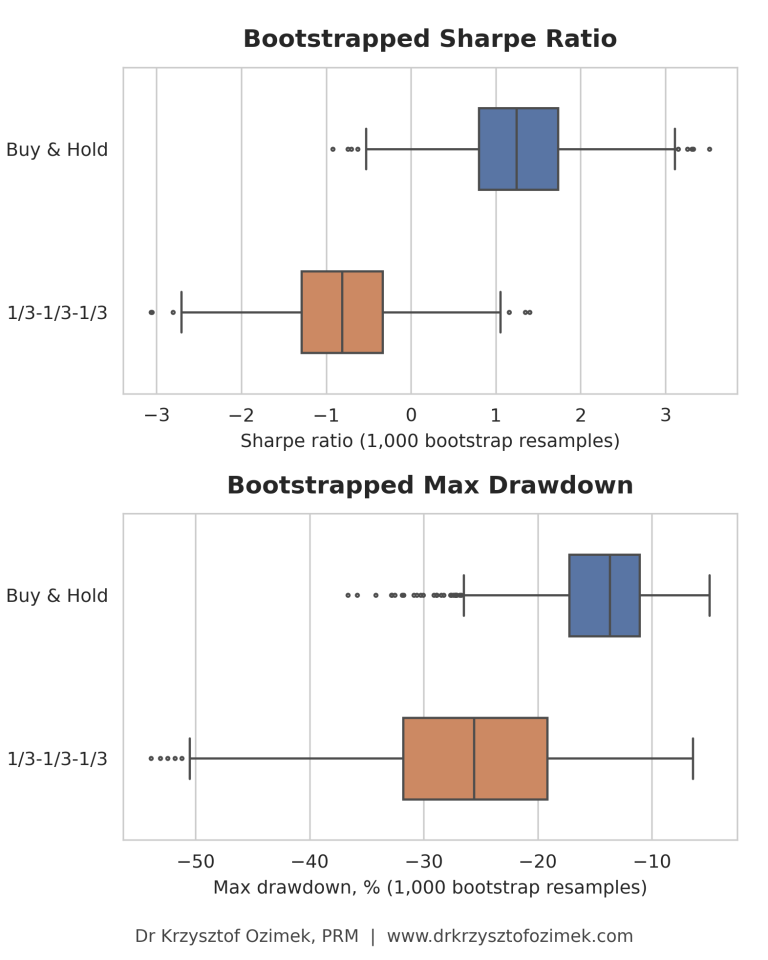
This post builds on my earlier post, where I discussed comparing trading strategies from a distributional perspective. Here I show a simple implementation using Pyfolio Reloaded’s bootstrap tools and seaborn. For readers interested in a more rigorous statistical treatment—modeling the full conditional distribution of the performance metric—I discuss the approach using GAMLSS

In the first post (1/4), a GAMLSS fit picked SHASHo over Normal for the Sharpe ratio estimator (López de Prado et al., 2026) — all four parameters statistically significant, a better GAIC than Normal, and an exact transform (R transform) to standard Normal already in hand.