
Options Pricing with Python, 1st Edition — Book Review
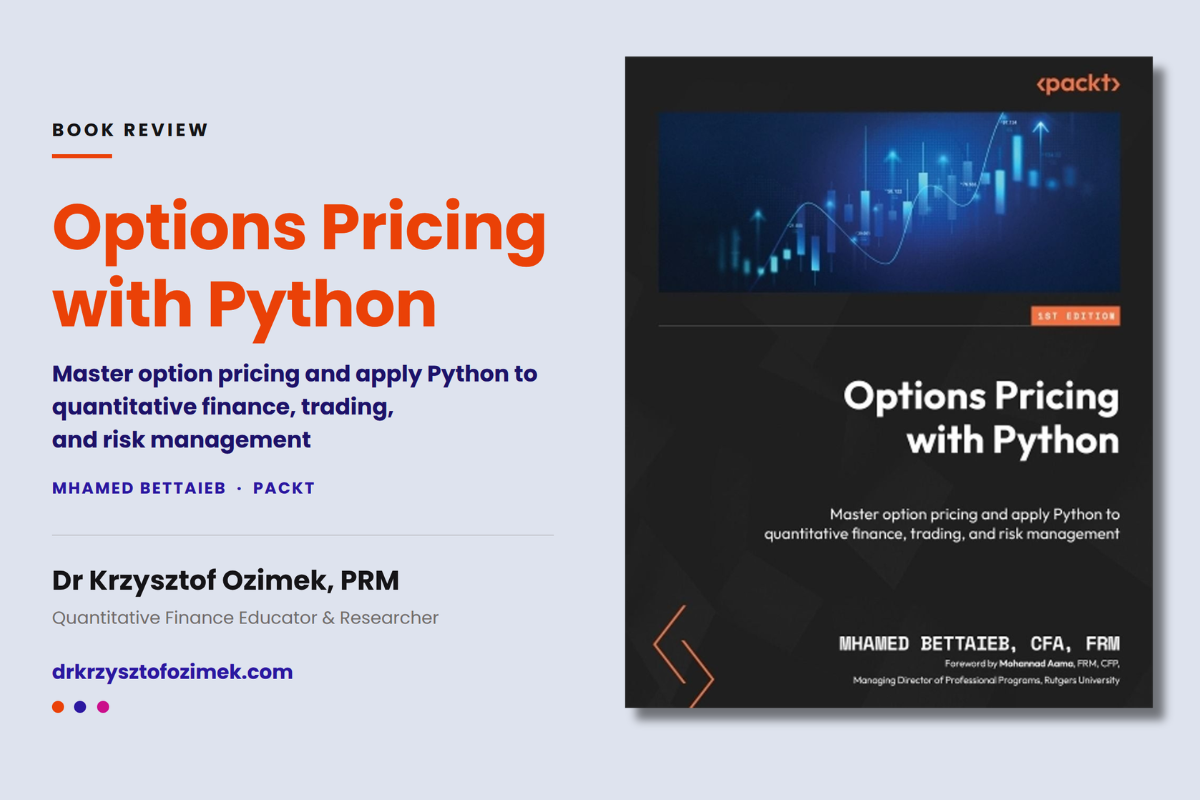
Gifted review ticket from Packt Publishing — honest, unpaid opinion below.
Reading it as a quantitative finance researcher and educator, I found it works well as a bridge between derivatives theory and reproducible code.
The book is built as a workflow, not a formula catalogue. In the core model chapters (4–10), the main techniques are implemented in Python and each chapter closes with a limitations section.
Data comes first. Chapter 3 works with a real AAPL option-chain snapshot (yfinance + FRED rates) and synthetic CME futures-options chains, with synthetic Cboe index options as a structural reference. It also covers cleaning, outliers and volatility grids.
Sanity checks from the very first implementation. Chapter 4 pairs the code with put-call parity ($C - P = S - K e^{-rT}$), the author's cross-checks against third-party calculators, spot/volatility stress runs, and a comparison of European model prices with American AAPL option-chain quotes from Chapter 3, with the mismatch stated openly.
A pricing ladder, in chapter order: Black-Scholes → binomial/trinomial trees → Monte Carlo (normal and t-distributed shocks) → implied volatility, GARCH on simulated returns, a SABR smile illustration → Greeks including Vanna, Volga, Charm, Speed, Zomma, Color → exotics → Crank-Nicolson finite differences for European options. Trees are checked against Black-Scholes.
Chapter 14 runs four ML case studies: option-price and implied-volatility approximation, then two reinforcement-learning examples. In the RL hedging test, the agent learns hedge adjustments directly from repeated interaction with a simulated market and materially cuts the risk of an unhedged short call, yet the Black-Scholes delta hedge still wins. A controlled proof of concept, not a production system.
Where I would push further as a teacher:
- The calibration example in Chapter 11 is illustrative: five strikes, one flat $\sigma$. It exposes the limits of a constant volatility, but a real validation protocol needs a full surface and arbitrage checks.
- Chapter 14's ML pricing case uses a random 80/20 split on a single-day snapshot, and implied volatility, derived from the option price, is among the features. That makes it a surface approximation, not a forecast, and the book acknowledges the snapshot limit. Out-of-time tests on multi-day chains are a natural extension.
Best fit: options traders, quants, risk managers, graduate students, and aspiring algo traders. Modular by design, though later chapters reuse Chapter 3's setup and, in places, its data.
In short: a practical, well-organised route from option basics to numerical methods and ML, candid about where its models stop working. Far more upskilling inside than my character limit let me show.

