
What Does MSE = 0 Actually Require?
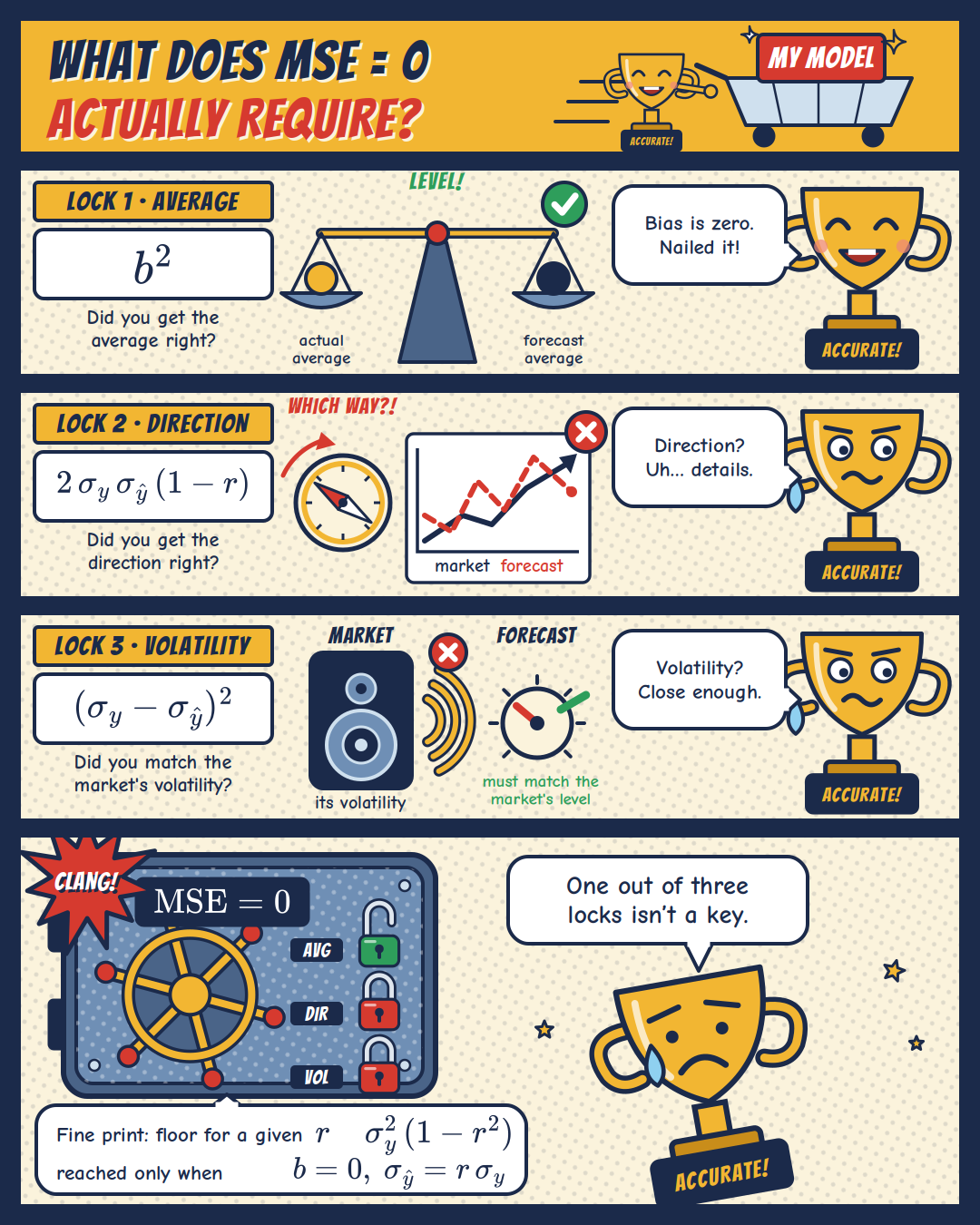
What does Mean Squared Error (MSE) actually require to reach zero?
It's not uncommon for a forecast evaluation to collapse to one number: MSE. It sounds like a single, honest measure of "how wrong were you." It isn't one thing — it's three, bundled into one number, and most reporting only ever checks one of them.
Split it out formally. $\hat y$ is the forecast, $y$ the outcome, $r$ their correlation, $\sigma_y$ and $\sigma_{\hat y}$ their volatilities, $b=E(y-\hat y)$ the bias. The full identity, no assumptions needed:
$$\text{MSE}=E[(y-\hat y)^2]=\sigma_y^2+\sigma_{\hat y}^2-2r\sigma_y\sigma_{\hat y}+b^2$$
Complete the square and it splits cleanly into three pieces, each one on its own, none of them negative:
$$\text{MSE}=(\sigma_y-\sigma_{\hat y})^2+2\sigma_y\sigma_{\hat y}(1-r)+b^2$$
Each term is a separate promise. $b^2$ asks: did you get the average right? $2\sigma_y\sigma_{\hat y}(1-r)$ asks: did you get the direction right? $(\sigma_y-\sigma_{\hat y})^2$ asks: did you get the volatility right? $\text{MSE}=0$ needs all three to vanish at once. Keeping two out of three costs you nothing on paper — and substantially in practice.
$\text{MSE}=0$ has exactly one solution: $\hat y=y$ ($\sigma_{\hat y}=\sigma_y$, $r=1$, $b=0$) — every single draw, not approximately. In the realistic case, with $r$ somewhere in $(0,1)$, getting $b=0$ and $\sigma_{\hat y}=r\sigma_y$ instead gets you to the achievable floor: $\text{MSE}_{\min}=\sigma_y^2(1-r^2)$ — not zero, but the best any forecast at that correlation can do.
So next time a model gets called "accurate," ask which of three sources that claim is resting on: average accuracy, association, or volatility accuracy. MSE only reaches zero when all three hold.

