
Large Language Models in Finance, 1st Edition — Book Review
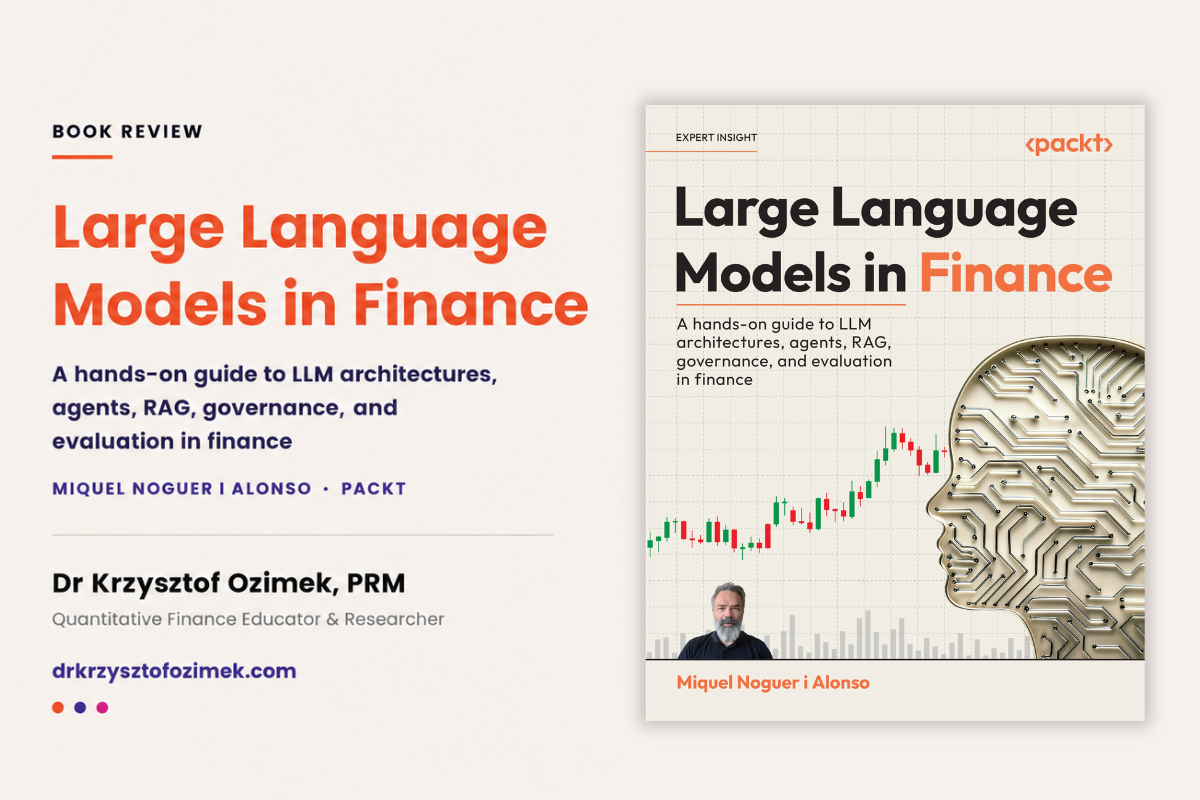
Reading this as a financial quant researcher and educator, not as a general AI reader — and it holds up well against that lens.
The backbone is a four-layer discipline running through all 15 chapters: every idea is (1) motivated by a real financial workflow, (2) formalized mathematically, (3) mapped to inspectable code, (4) bounded by a governance/validation protocol. Over 200 helpful numbered equations, highly instructional 40 code listings and 21 algorithm boxes, 36 enlightening diagrams/schemes, 42 distinctively structured tables — all of it not decoration, but spot-on facilitation.
One of the single most valuable sections for a working quant: the pitfalls-in-backtesting material. It formalizes look-ahead bias through filtration and catalogs six LLM-specific leakage channels missed by classical checklists — illustrated by a self-critical example from the author's own FinEAS paper, where a random split roughly doubles the reported error versus a true out-of-time holdout. Honest, and rare — and a genuinely good classroom case study.
Multi-agent trading systems (FinMem, TradingAgents, FinCon/FinAgent) all get real mathematical formalism, not just architecture diagrams — plus an explicit "backtesting caveats" section: limited scope, simplified cost modeling, short horizons, under-documented leakage risk. A useful antidote to hype-driven papers.
"Generative Alpha" gets a careful formal definition as a factor-model intercept, guarding against the common mistake of reporting the mean of a residual as alpha. It's paired with a strategy-search protocol that keeps an audit trial ledger of every candidate tested, not just the winner — the same anti-overfitting discipline, applied to the alpha claim itself.
Practically usable: FinBERT/FinEAS/FinGPT are covered as concrete, freely available building blocks, alongside worked reward-function designs for RL-based trading, hedging, and portfolio construction — framed as research templates, not deployable systems.
It earns its place as learning material too — most readers will study it solo, not teach from it: the recurring motivate→formalize→implement→govern structure, plus a pinned, reproducible companion repository, support genuine self-study, not just citation from a distance.
It isn't trading-only. Risk, compliance, technology, and governance chapters get equally serious treatment — MCP tool governance, SEC AI-washing case studies, document intelligence.
Briefly summarizing, this book is a stunning combination of solid foundations and practical guiding.

