
Building AI Agents for Finance, 1st Edition — Book Review
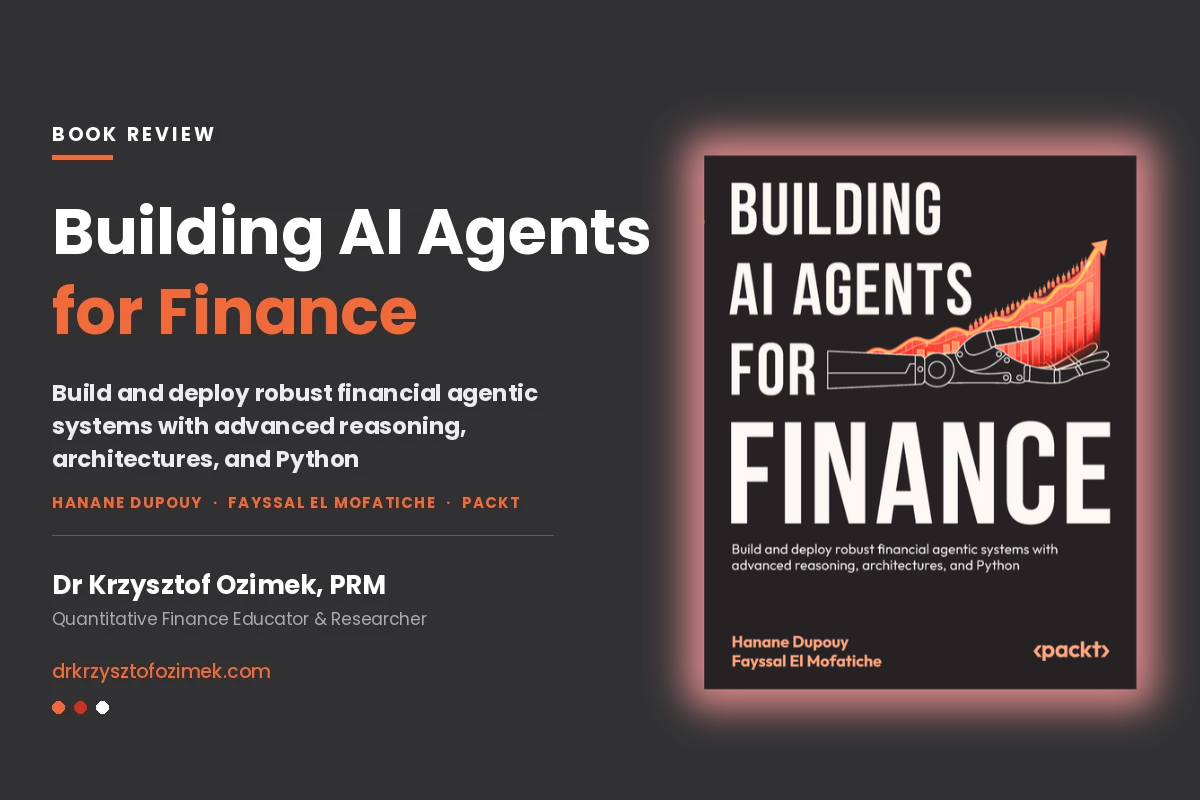
Gifted review copy from Packt Publishing — honest, unpaid opinion below.
I just finished reading a review copy of "Building AI Agents for Finance" by Hanane Dupouy and Fayssal El Mofatiche (Packt Publishing, 2026). If your career sits at the intersection of capital markets, data science, and enterprise tech, this book is an absolute must-read.
General Characteristics
This is not another surface-level blueprint or high-level manifesto about how generative AI will disrupt Wall Street. It is an exceptionally practical, honest, and rigorous engineering guide. Written by industry veterans with deep backgrounds in algorithmic trading and quantitative advisory, the book focuses entirely on moving past brittle prototypes to deploy production-grade multi-agent architectures that can actually satisfy strict institutional risk and compliance committees.
Most Important & Outstanding Parts
What makes this book truly phenomenal is how every technological concept is anchored directly to the harsh realities of a highly regulated industry. Here are the highlights that stood out to me most:
- The Framework Bake-Off (Chapter 3): An incredibly pragmatic comparison of modern developer stacks (OpenAI Agents SDK, LangChain, AutoGen, PydanticAI, etc.) running the exact same financial task. The authors provide a score-based decision matrix to help you defend your framework choices to enterprise architecture and compliance stakeholders.
- Reasoning Paradigms and Multi-Agent Debate (Chapters 6 & 8): Financial markets generate highly adversarial data where a single passthrough prompt fails. Chapter 6's hands-on Python labs map out reasoning techniques from Self-Refine and ReAct to Tree-of-Thoughts and Language Agent Tree Search (LATS); Chapter 8 carries that same adversarial rigor into a multi-agent investment committee stress-tested by a "bull vs. bear debate layer" — pure gold.
- Operationalizing Responsibly (Chapter 11 & 12): This is where the book shines as a regulatory asset. The authors treat agent evaluation as an engineering discipline (using a KYC agent case study). It provides the exact telemetry, drift detection, and compliance tooling required to align agent code with the EU AI Act and US model risk guidance (SR 11-7 / SR 26-2).
Summary
"Building AI Agents for Finance" is a brilliant, zero-fluff bridge between cutting-edge LLM reasoning and institutional market realities. It skips the hype to deliver composable blueprints that handle real-world complexities like token costs, sandboxing, and data normalization. If you want to build autonomous systems that turn brittle prototypes into production-ready results, this is your new foundation.

