
Hands-on Financial Trading with Python, 2nd Edition — Book Review
Gifted review ticket from Packt Publishing — honest, unpaid opinion below.
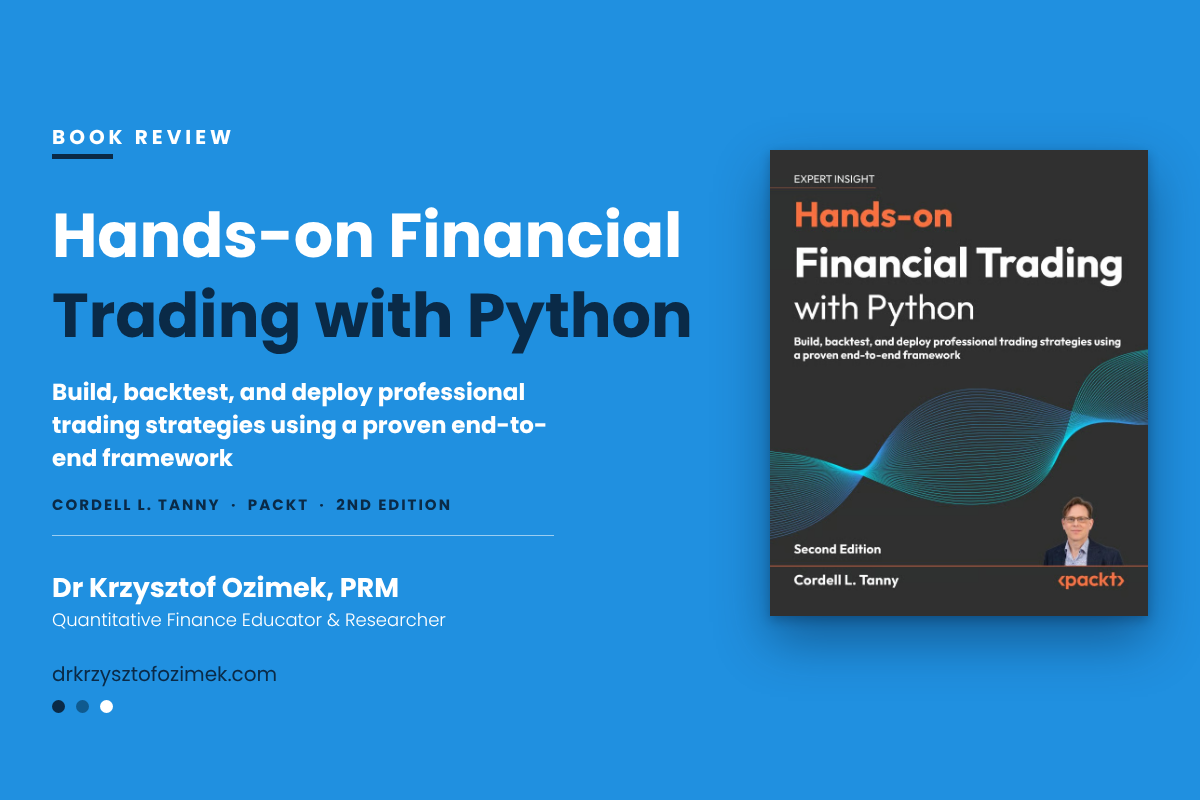
Book review: "Hands-on Financial Trading with Python", 2nd Edition — Cordell Tanny (Packt, 2026)
Reading it as a quantitative finance researcher and educator, I value most that it teaches how not to fool yourself before capital is at risk.
AI in the workflow (Ch. 2). Generative AI changes how you write code, not what you write: you stay the architect, set rules before any code appears, and test everything it returns.
One process. A VIXY tail hedge runs through many chapters as the case study, from data to unattended deployment, with Python notebooks and a downloadable code bundle. Evaluation and validation (7–11) come before the chapters that build more strategies and ML signals.
Avoiding false discoveries (Ch. 7). Success is defined first, then tested against luck: among many strategies flipping a coin between SPY and T-bills, a few reach high Sharpe ratios, and the best beats the book's VIXY hedge. Tests exist to catch losers, not to crown winners.
Pre-registration and holdouts (Ch. 9–10). Success criteria are written down before the test, so an ambiguous result cannot be rescued by new rules. Ideally the data is split three ways, with the holdout run once. Walk-forward analysis has a trap: with a forward-looking target, the obvious year-end cutoff lets future information in, so it must move back by a full target horizon.
Lookahead bias in code (Ch. 11). In a paired SPY/AGG switching strategy, normalizing a signal with full-sample statistics inflates CAGR and Sharpe, yet the book's red-flag checklist gives the flawed and the correct version the same verdict. The fix is one line: an expanding window.
Forecasts under test (Ch. 12–16). ARIMA, logistic regression and Prophet are run walk-forward. A four-gate test asks whether machine learning is needed at all: for a large one-day S&P 500 drop, turbulence features flag the size of a move, not its direction, and the model does not beat a fixed blend. Can an LLM turn Fed statements into a signal? On direction, no.
Strategies drawn from published research and practice (Ch. 13) share one pipeline and one question: does the signal truly earn its keep? A knockout test removes one component at a time to find out, and the Bollinger Band system is the deliberate exception that fails.
Chapters 17–18 take the strategy out of the notebook: a GitHub repository with secrets kept out of the code, a scheduled server run, Telegram alerts, failures broken on purpose to show they stay contained, and a frank list of what is missing before real capital.
In short: a process book that rewards skepticism over backtest polish, and shows negative results as plainly as positive ones. This approach truly captivated me.
Review copy courtesy of Packt.
Related
- Workshop: Build and Stress-Test a Multi-Asset Portfolio with Python (28 November, live online)
- After the workshop, a recording is expected to be included in the 6- and 12-workshop passes of the Packt ML & AI Engineering Membership Pass (affiliate link).
More book reviews

